Pedestrian and Bicycle Signal Layout Guide
date:2026-07-16 15:43:29
Mixed pedestrian and bicycle crossings look straightforward on a plan, but small layout decisions can change how quickly people understand the signal. A walking figure that is clear to a pedestrian may be mistaken by a cyclist approaching at a different angle. A bicycle display mounted too close to the vehicle signal can also be read by the wrong road user.
The signal head should therefore be selected after the movement paths, waiting areas and controller phases are agreed. This guide covers the practical questions that should be settled before choosing a pedestrian or bicycle signal product.
Begin with the users and their approach paths
Mark the pedestrian route, bicycle route, waiting position and intended sight line on the crossing drawing. Note whether cyclists remain mounted, share the pedestrian area or use a separate cycle track. The answer affects the symbols, mounting height, display direction and the need for separate signal groups.
At a simple parallel crossing, pedestrians and cyclists may receive permission at the same time. At a protected junction, their movements may conflict with turning vehicles or with each other. Do not assume that a combined face means a combined controller phase.
Separate heads or one combined display?
| Arrangement | Useful when | Check before approval |
|---|---|---|
| Separate pedestrian and bicycle heads | The paths, phases or viewing directions are different | Each user can identify the display intended for them |
| Combined pedestrian/bicycle face | The movements run together and pole space is limited | The symbols remain legible at the planned distance |
| Symbol with separate countdown | The project requires a larger or independently positioned timer | The timer is unambiguously associated with the correct movement |
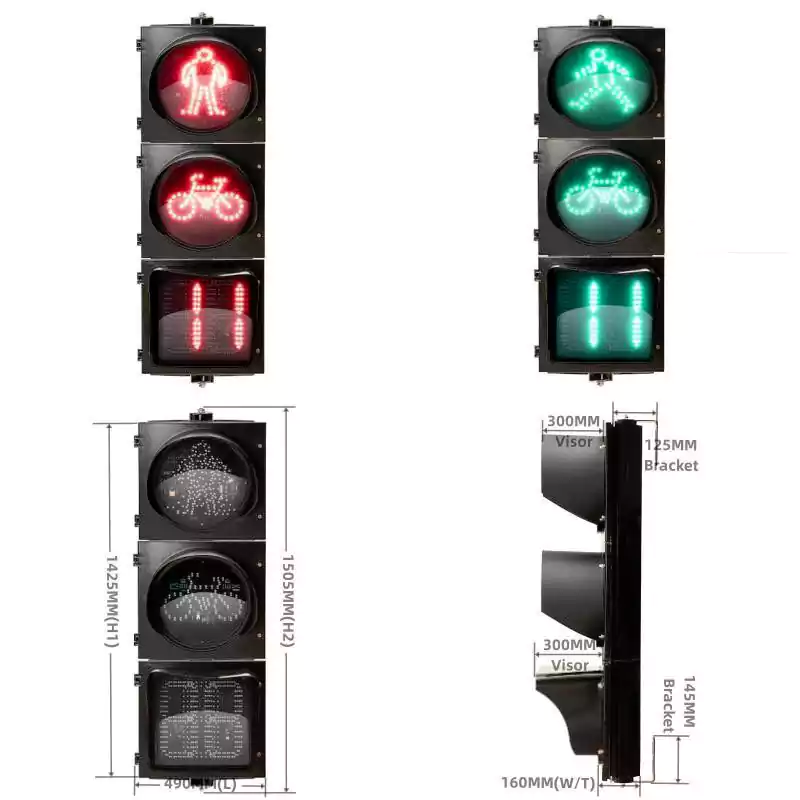
| Integrated symbol and countdown housing | A compact assembly is preferred | Controller interface, digit range and service access are compatible |
For examples of integrated assemblies, see the pedestrian and bicycle signal with countdown and the 400 mm mixed-crossing signal.
Place each face for the intended viewer
Viewing distance is only one part of placement. Check the angle from the waiting line, the approach angle for cyclists, nearby vehicle signals, foliage, parked vehicles and street furniture. A display that is bright in a workshop can still be difficult to identify against a busy background.
- Keep the pedestrian face aligned with the pedestrian waiting area rather than the center of the carriageway.
- Place the bicycle face where an approaching cyclist can see it without looking away from the path.
- Use visors and mounting angles to reduce unwanted views from conflicting approaches.
- Confirm that signs, push buttons and poles do not narrow the accessible route.
- Check both daytime sun position and nighttime background lighting.
Face diameter should follow the approved design and the actual viewing conditions. The site includes 300 mm signals and 400–500 mm signals for different layouts, but diameter should not be selected without a sight-line check.
Write the movement sequence before choosing the controller outputs
List every vehicle, pedestrian and bicycle movement in a phase table. Mark which movements may run together and which are conflicts. Include the walk or cycle-start period, clearance interval, all-red interval where required, and the response to a push button or detector call.
If pedestrians and cyclists use separate phases, they normally need separate controller groups even when their heads share a pole. If they run together, verify whether the project still requires independent monitoring or different clearance times. The controller and signal supplier should receive the same approved sequence.
Detection and push-button details belong in the signal plan
A push button is not simply an accessory. Its position, orientation, feedback and controller input determine whether it can be used comfortably. Where bicycle detection is provided, state whether it uses a loop, radar, video or another sensor and how a missed detection is handled.
For a conventional request input, review the pedestrian crossing push button. The project specification should still define accessibility, tactile or audible feedback and local mounting requirements rather than relying on a catalog photo.
Countdown displays need a clear meaning
State exactly which interval the digits represent. A pedestrian clearance countdown, a red waiting-time display and a green remaining-time display are different functions. The display must follow the controller when a phase is extended, shortened, skipped or manually interrupted. If the timing is variable, confirm how remaining time is communicated instead of assuming the display can predict it.
Information to include in the signal-head schedule
- Pedestrian, bicycle or combined symbol artwork.
- Red, green and countdown color arrangement.
- Face diameter, overall housing dimensions and orientation.
- Input voltage and controller switching or communication method.
- Mounting height, pole position, bracket and viewing direction.
- Push-button or detection inputs linked to the movement.
- Required drawings, labels and model-specific approval documents.
Commission the crossing from the user’s position
Testing should include more than switching every lamp. Observe the sequence from each waiting area and bicycle approach. Confirm that the wrong user cannot easily mistake a nearby green display for their own, that countdown digits agree with the active phase and that a detector or push-button call is acknowledged. Repeat the test during a timing-plan change and after a power interruption.
Frequently asked questions
Can pedestrians and bicycles use the same signal face?
They can when the project rules permit a combined symbol and the two movements operate together. Separate displays are clearer when routes, phases or viewing directions differ.
Should bicycle signals be the same size as vehicle signals?
Not necessarily. The approved size depends on approach speed, viewing distance, placement and local requirements. A dedicated bicycle face must remain easy to identify without being confused with the vehicle signal.
Can one countdown serve both users?
Only when it represents the same interval for both movements and its association is visually clear. Otherwise, use separate displays or omit the shared timer.
What drawing is most useful for a quotation?
Send a plan view of the crossing, a front view of every signal assembly, the phase table, controller voltage and mounting detail. These documents answer more questions than a product reference alone.
For a mixed-crossing configuration, send the layout and movement sequence to GAOQIAO so the display arrangement can be checked against the available signal heads.
Always On Your Way, Always Protect You! Top Chinese Traffic Light Manufacturer: NJGQ
ur focus and advantages are: traffic light & traffic light controller, whether it is normal power or solar power, portable or mobile, normal or solar warning traffic light, all kinds of traffic signal board, as well as light poles.