
Bản dịch đầy đủ của trang này đang được chuẩn bị. Một số nội dung được hiển thị bằng ngôn ngữ gốc.
Khám phá trang
date:2026-07-16 15:43:29
The housing is the part of a traffic signal that installers handle and maintenance teams keep for years. It supports the LED modules, visors, doors, terminals, seals and brackets while resisting weather and vibration. Choosing between polycarbonate and aluminum is therefore a maintenance decision as much as a material decision.
Neither material is automatically better for every project. The correct choice depends on weight limits, corrosion exposure, impact risk, service method, local approval and the spare parts already used by the operator.
Material comparison at a glance
| Yếu tố | Polycarbonate housing | Aluminum housing |
|---|---|---|
| Khối lượng | Usually lighter, which can simplify handling and reduce load on brackets | Usually heavier; structural and installation loads should be checked |
| Ăn mòn | The base material does not rust, but hardware and coatings still matter | Needs a suitable alloy, finish and compatible fasteners for the environment |
| Impact behavior | Can absorb impact well when the resin and molding are suitable | Rigid and robust, but a severe impact may dent or distort the casting |
| Heat transfer | Lower thermal conductivity; internal design must manage heat | Conducts heat more readily, although module design remains important |
| Finish | Color may be molded in or coated | Commonly painted or powder coated |
| Repair planning | Doors and molded parts should match the exact housing series | Cast parts, hinges and finishes should remain available for the installed series |
Do not select from material name alone
“Polycarbonate” covers different resin grades, wall thicknesses and molding quality. “Aluminum” covers different alloys, casting methods and surface treatments. Ask for the dimensional drawing, complete assembly weight, finish, mounting detail and model-specific test evidence required by the project.
The enclosure performance also depends on joints and openings. A strong shell cannot compensate for a poorly seated gasket, loose cable gland or warped service door.
Match the housing to the site environment
Coastal and corrosive locations
Review the housing, fasteners, hinge pins, brackets and cable fittings as one system. Dissimilar metals can create local corrosion. Polycarbonate avoids metal corrosion in the shell, but exposed screws and brackets still need suitable protection. Aluminum needs an appropriate finish and careful treatment of cut or damaged areas.
Industrial and tunnel installations
Exhaust residue, cleaning chemicals, vibration and restricted service access may be more important than rain. Confirm chemical compatibility, door access and how the signal can be cleaned without damaging the lens or finish.
Hot sun and high UV exposure
Color stability, resin UV resistance, gasket aging and internal temperature should be reviewed. Ask how the complete model was evaluated rather than assuming every housing of the same material behaves alike.
Temporary and portable systems
Low weight helps frequent transport, but repeated handling can damage doors, visors and cable entries. Check how the housing is protected during transport and whether field-replaceable parts can be carried with the trailer.
Face diameter does not define the replacement housing
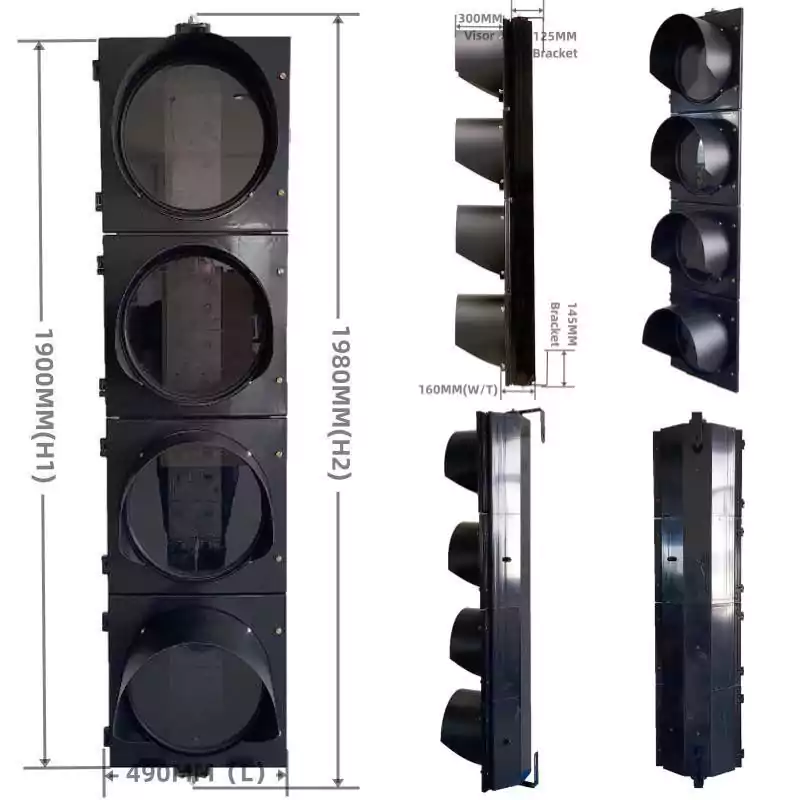
Two 300 mm housings can have different overall widths, door hinges, bracket centers, module-retaining rings and cable paths. When replacing an existing unit, record:
- Manufacturer and model marking.
- Front, rear and side photographs.
- Overall height, width and depth.
- Bracket-center distances and bolt sizes.
- Door opening direction and hinge arrangement.
- Module diameter and retaining method.
- Terminal position and cable entry.
Browse the traffic light accessories and spare parts category, along with the 300 mm four-section housing và 400 mm four-section housing.
Inspect the service details before ordering
Ask an installer to review the drawing, not only the purchasing team. The installer will notice whether the door can open near the pole, whether the terminal is reachable, whether the visor can be replaced independently and whether the bracket allows the required aiming angle.
For a retrofit, obtain one production-representative sample and fit it to the existing pole and module before releasing the full quantity. This simple check can reveal small dimensional differences that are expensive to correct in the field.
Plan spares around the installed housing family
A practical spare kit may include visors, doors, gaskets, hinges, module retainers, terminal blocks, brackets and fasteners. Keep the approved drawing and parts list with the maintenance record. Mixing visually similar parts from different housing series can compromise fit and sealing.
Routine housing inspection
- Look for cracks, dents, loose visors and damaged finishes.
- Check door closure, hinge movement and gasket compression.
- Inspect cable entries for movement or water paths.
- Check mounting bolts, bracket alignment and vibration marks.
- Clean the lens using a method compatible with its material.
- Record the model and any replaced parts for future orders.
Traffic light housing FAQ
Is aluminum always more durable than polycarbonate?
No. Durability depends on the exact material, design, finish, environment and maintenance. Compare complete models and project evidence rather than material names alone.
Can an LED module from one housing fit another?
It may fit when the diameter, retaining system, depth, connector and electrical design match, but this should be confirmed from drawings or a physical trial.
Can a damaged visor be replaced without changing the housing?
Often yes when the visor is a separate service part. Confirm the housing series and mounting points before ordering the replacement.
What is the most important retrofit measurement?
There is no single measurement. Overall dimensions, bracket centers, module retention, door clearance and cable entry must all match the existing installation.
For a replacement housing inquiry, send photographs and a marked dimensional drawing so the parts can be compared before shipment.
Luôn đồng hành trên đường, luôn bảo vệ bạn! Nhà sản xuất đèn giao thông hàng đầu Trung Quốc: NJGQ
Trọng tâm và thế mạnh của chúng tôi gồm đèn giao thông và bộ điều khiển, nguồn thông thường hoặc mặt trời, loại xách tay hoặc di động, đèn cảnh báo thông thường hoặc mặt trời, các loại bảng tín hiệu và cột đèn.
Hướng dẫn liên quan: vỏ và bảo vệ
Tham khảo thêm các tài liệu liên quan cho dự án tín hiệu giao thông.