
A tradução completa desta página está sendo preparada. Parte do conteúdo é exibida no idioma original.
Explorar página
date:2026-07-16 15:43:29
A lane control signal gives one instruction about one lane: available, closed, merge or proceed in a defined direction. The familiar green arrow and red cross appear simple, but a reliable installation depends on viewing geometry, controller interlocking and a fault state that cannot invite traffic into an unsafe lane.
Tunnels, toll plazas, car parks, loading facilities and reversible lanes use similar symbols for different operating reasons. The project should describe the lane decision first, then select the face size, housing and controller interface.
Define the indication set in words and drawings
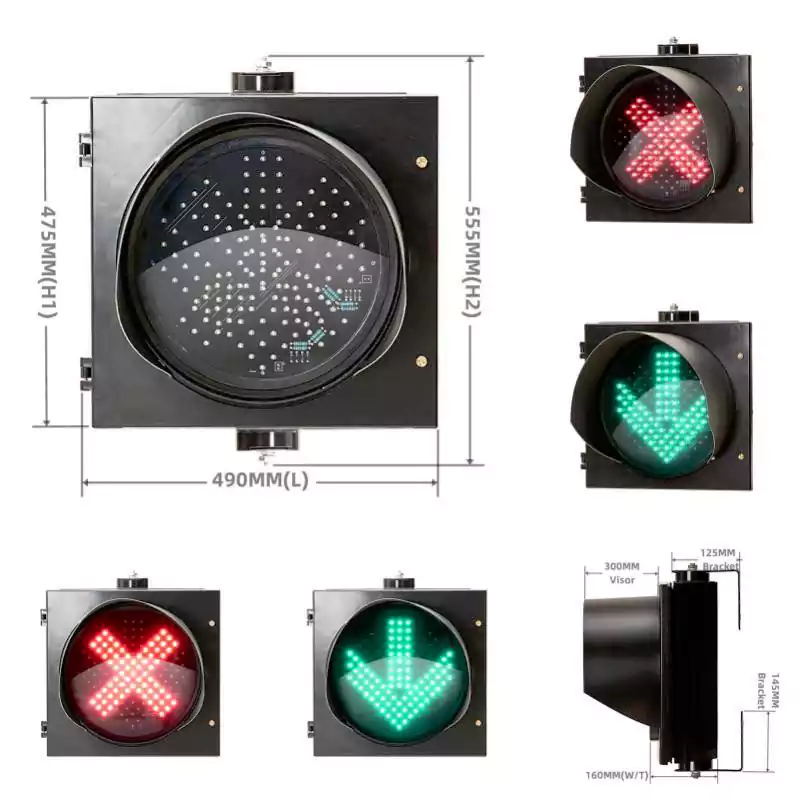
“Lane control light” may refer to a bi-color face, two stacked modules or a larger matrix sign. State every permitted symbol and color on a front-view drawing. If a diagonal arrow means merge left or right, include its orientation from the driver’s point of view.
A single-face module is compact and works well where one location alternates between open and closed. Separate faces can provide larger symbols or a more familiar arrangement. Browse the 1-aspect traffic light range e o 400 mm red-cross/green-arrow signal for typical formats.
Tunnel placement requires a brightness-transition check
At a tunnel portal, the driver’s visual environment can change rapidly. Check the signal against daylight near the entrance, the darker interior, tunnel lighting and reflective signs. Mounting directly above the controlled lane usually gives a clearer association than a side position, but the final arrangement must fit the structure and clearance envelope.
- Verify the recognition distance from every lane approach.
- Check whether curves, ventilation equipment or signs block the view.
- Use aiming and visors to limit misleading views from adjacent lanes.
- Consider duplicate displays where one unit could be hidden by large vehicles.
- Plan safe maintenance access without closing more lanes than necessary.
Toll and parking signals often depend on external equipment
At a toll lane, the signal may follow payment equipment, a barrier, an operator console or a lane-management system. At a car park, it may follow a loop detector, access-control relay or space-management system. Document the complete input chain and identify which device has final authority to show green.
Relay contacts, switched voltage outputs and data communication are not interchangeable. Include the interface voltage, contact rating, logic state and cable distance in the request. If the signal is controlled by a simple gate relay, decide what indication appears while the gate is moving or when position feedback is missing.
Interlocking is the central safety requirement
The controller should prevent a red cross and green arrow from being displayed together unless a specific approved symbol design intentionally combines them. For reversible lanes, opposite-direction green indications must also be interlocked. The control design should define:
- Normal open and closed states.
- Transition sequence and clearance time.
- Manual override permissions.
- Response to conflicting commands.
- Response to communication loss, lamp fault or controller restart.
- How the operator confirms the displayed state.
Traffic should never receive an invitation based only on a software command that has not been confirmed at the output. Depending on the project, feedback may come from current monitoring, a signal status input or a separate field device.
Choose a fail-safe state for each site
“Fail safe” does not automatically mean the same display everywhere. A tunnel lane may need to show a red cross after a communication fault, while a private parking aisle may use a blank or flashing warning state. The responsible project engineer or road authority should approve the fault response. The supplier needs that decision before programming the controller.
Housing, power and mounting details
| Item | O que especificar | Common omission |
|---|---|---|
| Face | Symbol, color, visible diameter and viewing angle | Arrow orientation not shown |
| Elétrico | AC/DC voltage, input circuits and power-loss state | Controller output diagram missing |
| Carcaça | Material, color, visor, cable entry and service access | Overall dimensions assumed from face size |
| Montagem | Overhead, wall or pole; bracket and aiming range | Structural clearance not checked |
| Ambiente | Temperature, water, dust, exhaust, vibration and corrosion | Indoor car-park exposure treated as a dry room |
Acceptance testing should use real operating commands
Test every normal transition, manual override and fault condition. Disconnect communication, interrupt power, introduce conflicting commands and verify the recovery sequence. From the approach, confirm that every displayed symbol is associated with the intended lane and remains recognizable under the expected lighting.
Lane control signal FAQ
Can one module display both the red cross and green arrow?
Yes. A bi-color module can place both indications in one face. The controller and wiring must ensure that the permitted combinations match the approved operating logic.
What face size is best for a tunnel?
There is no universal size. Use the required recognition distance, lane speed, mounting height, background lighting and authority specification to select the face.
Can a parking barrier control the signal directly?
It can when the interface and fault logic are suitable, but barrier position feedback and controller restart behavior should be considered. A dedicated relay or small controller may provide clearer interlocking.
Should the signal go dark after communication loss?
Only if the approved safety concept calls for a blank state. Many applications require a red cross or another restrictive indication. Put the required fault state in the control specification.
Compare 200 mm lane-control face with larger options, then send the lane plan and controller interface for a configuration review.
Sempre no seu caminho, sempre protegendo você! Fabricante líder de semáforos da China: NJGQ
Nosso foco e vantagens incluem semáforos e controladores com alimentação convencional ou solar, portáteis ou móveis, sinalizadores convencionais ou solares, diversos painéis de sinalização e postes.
Guias relacionados: sinais de faixa e advertência
Consulte estes recursos relacionados para seu projeto semafórico.